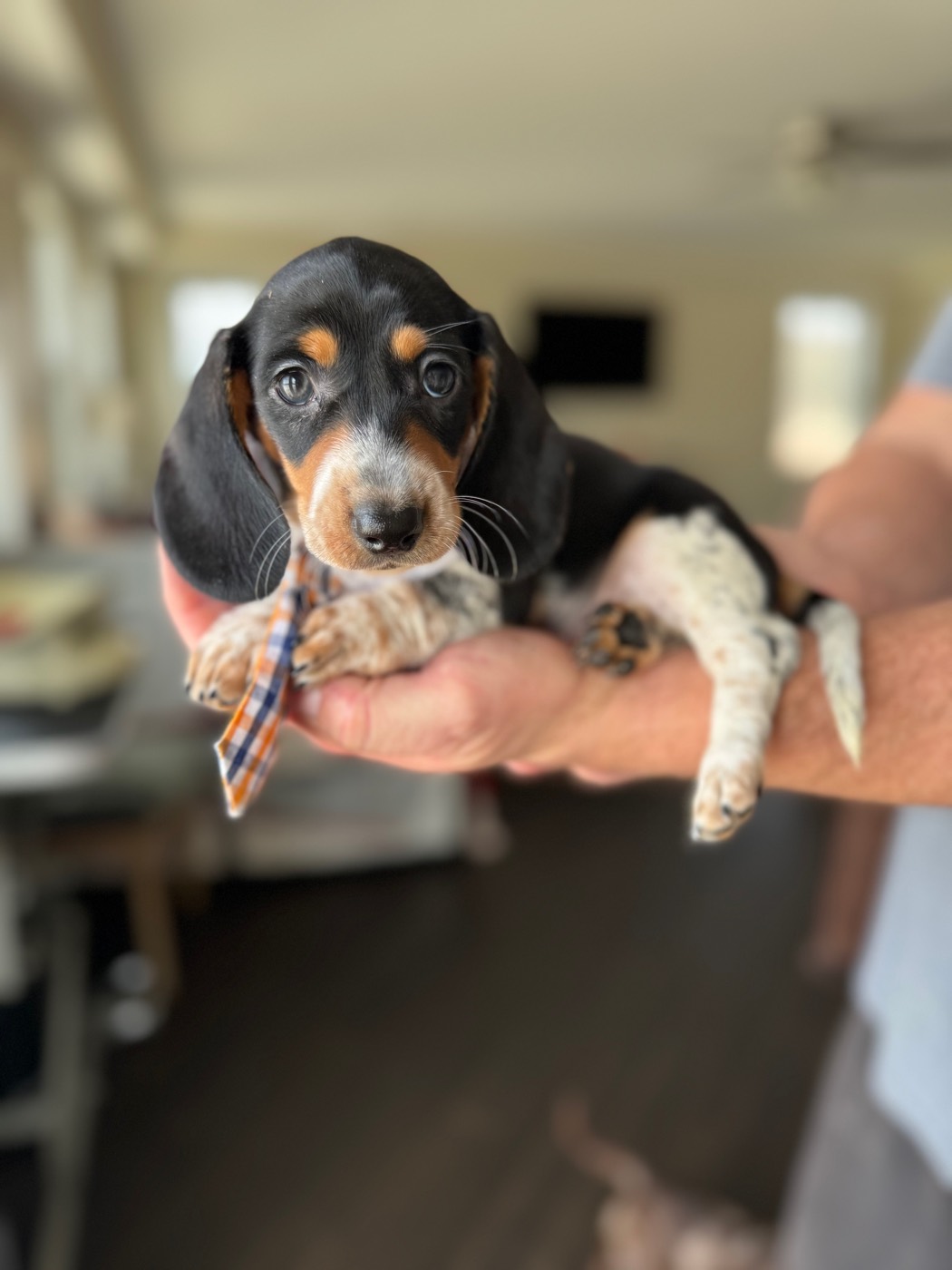
Puppy instructions
Feeding, sleeping, potty training, shots and training — everything we hand new families, in one place. Read it within a week of pickup, especially if this is your first dog.
We are so excited to help you embark on this journey with your newest family member, and we want you completely prepared to be the best puppy owner you can be. Below are the resources we hope you find helpful. Read through all of it within a week of your pickup — especially if you’re a new dog owner. Ground rules set in the very beginning greatly increase your chances of a well-behaved dog.
Feeding
We feed TLC Dog Food All Stages and Life’s Abundance products, plus NuVet daily vitamin for immune support.
- TLC Dog Food: All Stages — the food your puppy is already on
- Life’s Abundance — dog treats
- NuVet — daily immune system vitamin
- Pet Lab — chewy daily probiotic
- Bernie’s Perfect Poop — daily probiotic food topper; save 20% with code DoodsandDoxies
This food is nutrient dense, so it takes less of it. Start here, divided into 2–3 meals:
- Mini dachshunds — 1 to 1½ cups per day
- Miniature puppies — 2 cups per day
- Medium puppies — 2½ cups per day
Split that across three feedings a day, and you can drop to two feedings around the 12-week mark. As they grow you’ll need to increase the amount. If your pup gains too much once they reach maturity, green beans mixed right into the food are an excellent healthy filler that lets you cut back on kibble while keeping them full.
Keep fresh water available at all times, but take it away about four hours before bedtime while you’re potty training — we stop food by 5:30 and water by 6:00. Here’s a good guide to teaching your pup to wait for his bowl.
The first few nights
There’s nothing more exciting than bringing a new puppy home — and nothing more horrifying than discovering they pee and poo constantly and have zero respect for your need to sleep.
Your puppy has had a week of crate training with us, which dulls the confusion of being separated from their pack. We set the mood with lullaby music, loud enough to act as white noise; they sleep through the night sooner when there’s less to wake them. If you want to keep that going, try music, a fan or a white noise machine. Covering the crate with a blanket helps too — just don’t be surprised when they pull it through the bars and chew it.
We start the process at 6–7 weeks so the transition to your home is smooth, but any new environment is stressful. Expect to get up at least once a night for the first month or so. Some take longer, some get it in a few weeks. Be patient — they’re babies who need a diaper change in the middle of the night.
Our schedule: in bed by 11, up around 1–2am for a potty break, then back down until 6am.
Potty training
A pup who has started house-training basics is far easier to train than a kennel-raised dog. We start at three weeks old, teaching them to use one spot in their area and reinforcing the instinct not to go where they sleep. At five weeks we begin taking them outside after meals.
We’re quick to tell families that your puppy is not fully potty trained when they come to you. Eight weeks is the ideal age to join your family, and it is still too young to be reliably house trained — so you’ll have work ahead of you. Our head start should pay dividends. House training takes patience, commitment and a lot of consistency.
When to start
House training usually starts between 12 and 16 weeks, when your puppy has enough bladder control to hold it. From 8 to 12 weeks you’ll be focused on crate training.
Establish a routine
Dogs are programmed never to eliminate in their den, and part of that desire for a clean den comes from imitating their mother. Your job is to recreate what she did: set times for feeding, bathroom breaks, play and sleep. Conveniently, right after those times is when a puppy most often needs to go.
- Set a timer every 30 minutes and take your puppy outside.
- When they succeed at 30 minutes, stretch it to 45, then keep adding 15 minutes.
- If an accident happens, drop back by 15 minutes.
- While potty training, your puppy belongs in one of three places: playing directly with an adult (not children, unless supervised), in their kennel, or on a leash tied to something near you — so they can’t sneak off. That last one matters especially for dachshunds, who are amazingly swift about slipping away unnoticed.
Teaching your puppy to go promptly on command makes housebreaking far less of a hassle. Let playtime in the yard or a long walk be the reward for getting down to business in the right place. We take ours out as soon as they come out of the crate.
Decide where the potty area will be — back yard, front yard, the curb on a walk — and be consistent so your dog isn’t confused. Early on, go outside with your puppy on a leash even if the yard is fenced. You’ll be able to steer them to the right spot, keep them on task, see whether they actually went, and be there to praise them the moment they do. It also gets them comfortable going on a leash, which pays off at the vet and on trips. Always reward your puppy afterwards and tell them how fabulous they are.
As training progresses you’ll be able to open the door and let them out alone. At first, spy from a window to be sure they remember why they’re out there. If your puppy has an accident in the crate, be extra careful with the schedule in the days that follow and crate them only when they’re empty, so it doesn’t become a habit.
Best times to take your puppy out
- First thing every morning
- After meals
- After playing
- Before you leave
- When you get home
- After time in the crate
- After nap time
- Any time you’ll leave the puppy alone
- Before bedtime
If you’re not consistent, your puppy learns that anywhere in the house is fine. You can’t get upset with your dog if you aren’t doing your part and taking them out.
A few more things that help
- Treats work well for training. Practice recall in the house and yard with them.
- No excited greetings when you come and go — that builds separation anxiety. Instead make the crate a special place with a high-value treat they only get in there. Kongs filled with frozen peanut butter mixed with Greek yogurt are a favorite around here.
Training
Your puppy will understand “no,” but be firm with your voice so they can hear the difference between your good-boy tone and your no tone.
We start your puppy from day one on the Baxter & Bella program — a lifetime membership for a one-time fee, with puppy training videos and chats with real trainers for the life of your dog. They’re very puppy-parent friendly and make the transition from our home to yours much easier. As a breeder we have a code for you: DOODLES&DOXIES gets you 25% off. Check out Baxter & Bella.
Shots
- Your puppy needs a booster set of shots in one month with your vet.
- Take their current shot records with you so your vet can see what they’ve had.
- No dog parks or unfamiliar dogs until all shots, including rabies, are done at four months (16 weeks).
- Socialization is still crucial, so familiar dogs you know are vaccinated may play with your puppy — we encourage you to bring healthy vaccinated dogs to your puppy on their own territory.
Normal temperature
A normal dog temperature is 100.5–102.5°F. Get a digital thermometer so you can take your puppy’s temperature if they don’t look well, and call your vet if it’s over 102.5.
Stay in touch
Thank you so much for choosing Doodles & Doxies. We take pride in our program, so contact us any time with questions — and we would absolutely love updates and photos as your puppy grows. Reviews genuinely help us, so if your experience was a good one please leave one. And if you’re on Instagram, tag us in your puppy’s adventures at @doodlesanddoxies.
Some links on this page are affiliate links — they cost you nothing extra, and we only ever link things we’d hand a new puppy family ourselves.
Let’s find your puppy
Tell us about your home and what you’re looking for. We’ll be in touch personally — no automated runaround, no waiting list you never hear from again.
Start Your Application